You don’t have to be a forensics expert to make solid calls at the door. With a simple, repeatable workflow and the right tools, new hires can verify IDs confidently in 30–60 seconds while keeping lines moving and your venue protected. This guide is written for North Carolina bar, nightclub, and event door teams and reflects the state’s current credential design and enforcement expectations.
Quick disclaimer: This is practical training content, not legal advice. Always follow your venue’s policy and your ABC/ALE guidance.
Key takeaways
Use a fast, consistent flow—tactile feel, visual check, quick DOB math, UV sweep, barcode compare—then decide and document. Accept only recognized documents (e.g., driver’s license/state ID, U.S. military ID, passport); photocopies don’t count, and the ID should be current and match the person. North Carolina’s 2024 redesign uses polycarbonate and laser engraving with more than 50 security features; under-21 cards are vertical to aid spotting. The REAL ID star is about federal travel/access—not alcohol age; a standard, unexpired NC ID can still prove age if authentic. If you suspect a fake, escalate calmly; if retained, transfer the ID to law enforcement per NCGS 18B-129 and venue policy, and log the incident.
What you can accept at the door in North Carolina
Most venues rely on a short list of documents for age checks. According to the NC ABC Commission’s education materials, acceptable IDs include a current driver’s license from North Carolina or any other state, a North Carolina special identification card, a U.S. military ID, and an official passport. Photocopies aren’t acceptable for verifying age; the ID should be unexpired and reasonably describe the person presenting it, per the ABC quick guidance. See the NC ABC Commission’s overview in the Quick Guide for Retail Permittees (2024).
You’ll also see REAL ID vs. standard NC credentials. A REAL ID-compliant card shows a star in the upper right corner; standard cards say “Not for Federal Identification.” Both are valid for everyday identification; for door checks, focus on authenticity and age—not federal access rules. For context, review the NCDMV’s REAL ID FAQs.
Finally, format matters for speed: NC under-21 credentials are printed vertically. That helps you spot likely minors at a glance, as noted in the ABC training resources within the Quick Guide for Retail Permittees.
NC door-ready checklist — how to spot a fake North Carolina ID in 30–60 seconds
Here’s the deal: keep this sequence tight and consistent. If any step throws a real red flag, pause and move to secondary checks or escalate to a lead.
-
Pre-shift setup (about 10 seconds per station)
- Tools ready: bright white task light, a 365 nm UV flashlight, a small 10× loupe, and an AAMVA-capable PDF417 barcode scanner/app. Post your age policy where guests can see it. For equipment basics, the UK Home Office’s NDFU recommends 365 nm for document UV checks; see the government guidance on identity document validation technology.
-
Primary tactile and visual checks (10–15 seconds)
- Tactile feel: Current NC credentials (2024 redesign onward) are 100% polycarbonate with laser-engraved personalization—stiffer than old laminated PVC, with smooth text (not raised ink). The NCDMV announced the redesign and public features in May 2024; review the NCDOT press release on the new credential design (2024-05-28).
- Visual cues: Confirm the photo matches the person; look for the expected North Carolina imagery (e.g., dogwood, state outline, lighthouse) as noted publicly; check for an aligned ghost image; confirm orientation (vertical for under-21). Obvious tamper marks, spelling errors, or odd fonts are red flags.
-
Quick data check (5–10 seconds)
- DOB math: Confirm 21+ by month/day/year, not just year. Check expiration date and that the ID type matches what you’re seeing (DL vs. ID). If the math doesn’t work out, stop and escalate.
-
Secondary checks when something feels off (20–40 seconds total if needed)
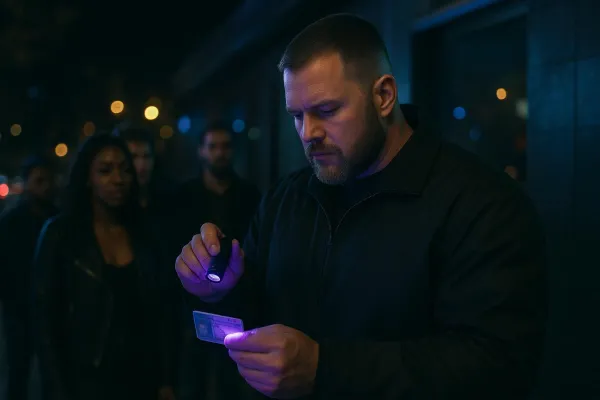
- UV sweep: In a shaded spot, use the 365 nm light. Genuine cards show defined UV elements; counterfeits may have no response or an all-over bright, blotchy glow. Don’t rely on covert placement specifics—stick to the general pass/fail behavior.
- Barcode scan and compare: Scan the PDF417 on the back and compare key fields—full name, date of birth, document number, expiration (and issue date/address if displayed). Any mismatch between scan and print is a major red flag. AAMVA publicly describes the role of the PDF417 in DL/ID standards; see the AAMVA DL/ID Card Design Standard 2025 overview.
- Brief questions: Ask for ZIP code, street number, or birthday month. Watch for hesitation, coached answers, or a glance down at the card for simple facts.
-
Decide, document, and move the line
- Accept if everything aligns. If doubts remain, call a shift lead. If you believe the ID is fake or altered and you retain it, North Carolina allows confiscation strictly to transfer to law enforcement under NCGS 18B-129—document and turn it over per policy. The NC ABC FAQ explains this allowance; see NC ABC’s General FAQ (confiscation). For serious fraud, venues typically notify ALE, which has statewide ABC jurisdiction; see the NCDPS/ALE overview on fake IDs.
Common red flags you’ll see (and what to do next)
- Flimsy or laminated feel; peeling edges; raised ink instead of smooth laser engraving. Action: Move to UV and barcode checks; likely refusal if confirmed.
- Photo doesn’t match patron (age, facial structure, or hairstyle tolerance is fine; but a different person is not). Action: Ask simple questions; if mismatch persists, refuse entry.
- Misspellings, strange fonts/spacing, or missing public NC imagery. Action: Treat as high risk; run full secondary checks.
- Ghost image badly misaligned or visibly tampered area. Action: Escalate to shift lead; consider refusal.
- No meaningful UV response or an overly bright, blotchy all-over glow. Action: Combine with other checks; counterfeits often glow uniformly.
- Barcode data doesn’t match printed data (name/DOB/expiry). Action: Major red flag—refuse and document.
- Behavior flags: Coached answers, can’t recall ZIP or birthday month, won’t remove hat/mask for a quick face match. Action: Slow down and verify; refusal if identity cannot be confirmed.
Privacy and scanning notes (North Carolina context)
Keep customer data exposure low. If you use a scanner/app, configure it to compare fields without storing personal data whenever possible. North Carolina’s Identity Theft Protection Act (Chapter 75, Article 2A) imposes data-security obligations on businesses that hold personal identifiers; review your policy and vendor settings. For a statutory starting point, see the Chapter 75 overview and the Article 2A text (Identity Theft Protection Act). Also ensure that any scanning aligns with the AAMVA-standard role of PDF417—match key fields and avoid unnecessary retention, as described in the AAMVA DL/ID Standard overview.
Post clear notice if scanning is used, and train staff on what’s collected (if anything), who can access it, and how long it’s kept.
Quick tools and training boosts
Two practical additions keep teams consistent: a simple incident/refusal log and one micro-drill you can run during lineup.
Incident/refusal log — suggested fields
|
Field |
Example |
|
Date & time |
2026-02-19, 11:42 p.m. |
|
Patron initials/description |
J.D., blue jacket, ball cap |
|
ID type/state |
NC DL |
|
Reason |
Barcode DOB mismatch vs. front |
|
Outcome |
Refused; ID retained for ALE |
|
Staff initials |
KB |
|
Notified |
Shift lead + ALE |
Training micro-drill
- Photo match sprint: Show three IDs (one real, one look-alike, one wrong age). Staff call pass/fail in five seconds each and give one reason. Repeat twice.
Short glossary
- REAL ID: A federal security benchmark for state-issued IDs. In NC, a star in the upper right indicates compliance; standard cards remain valid for age checks if unexpired and authentic. See the NCDMV REAL ID FAQs.
- Polycarbonate: A rigid plastic used in NC’s 2024 credentials; text and images are laser-engraved, producing smooth characters that resist tampering. Announced in the NCDOT redesign press release (May 28, 2024).
- PDF417 barcode: A 2D barcode on the back of U.S. DL/ID cards carrying encoded data that should match printed fields like name and DOB. See the AAMVA DL/ID Standard overview.
- UV 365 nm: A “black light” wavelength commonly used to observe security features in IDs. Operational guidance appears in the UK Home Office NDFU document validation guide.
—
Practice builds speed. Run the checklist the same way every time, escalate early when something feels off, and document decisions so your team keeps improving. Stay within policy, be respectful, and when in doubt, loop in a lead or ALE contact.