buying Fake Connecticut ID cards may fool an untrained eye for a moment, but they’re a liability magnet. For businesses, the real question is how to make fast, lawful decisions at the door or checkout so staff don’t accept counterfeits and don’t escalate situations unnecessarily.
Disclaimer: This guide is informational and not legal advice. For case‑specific questions, consult counsel and your local Liquor Control Division.
Quick 10–20 second check for frontline staff
Use this rapid scan during busy periods. If anything feels off, move to the deeper check.
- Match the photo and physical description (height, eye color, unique features). Do quick age math from the birthdate and confirm the credential isn’t expired.
- Tilt the card under light and feel for tactile elements; look for natural holographic movement rather than printed “foil.”
- If policy allows, perform a barcode scan to confirm format consistency; glance for any “Under 21” indicator when applicable.
How Connecticut issues IDs—and why counterfeits struggle
Connecticut uses central issuance, mailing finalized licenses/IDs after fraud checks and production, which raises the bar for counterfeiters and protects personal data. DMV explains the anti‑fraud purpose and REAL ID compliance on the official overview. See Connecticut DMV’s explanation of central issuance and identity protection in the DMV central issuance overview and the DMV brochure on redesigned credentials. While public pages avoid listing every security feature (to prevent abuse), the combination of production controls and embedded card features makes a polished fake Connecticut ID much harder to produce at scale.
How to spot a fake Connecticut ID: common tells
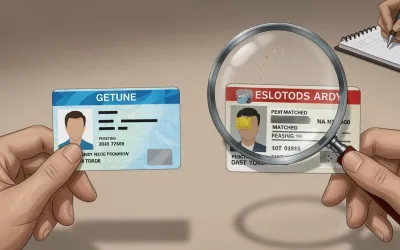
Counterfeits often fail on basics long before you need specialized tools. What should you look for?
- Artwork alignment and spacing: Misaligned borders, inconsistent margins, or text crowding near edges are red flags.
- Font and character issues: Incorrect fonts, uneven kerning, or off‑center numbers for birthdates and credential numbers.
- Missing or simulated effects: Printed “hologram” graphics that don’t shift under light; UV elements that don’t appear under a blacklight.
- Laminate and edge quality: Peeling corners, bubbles, or visible seams from home lamination.
- Barcode anomalies: Back barcode that won’t scan or returns data inconsistent with the printed front.
Example scenario: A cashier notices the birthdate font looks slightly bolder than the rest of the card and the hologram appears static under light. A quick barcode scan fails. The cashier calmly moves to the deeper check, asks for a secondary ID, and involves a manager. The situation is resolved without confrontation.
Tip: If you’re building a shift training, include the phrase “spot fake CT ID” in your materials so staff connect the skill with Connecticut‑specific cues and policy.
Deeper 30–60 second check and when to use scanners
When the quick scan raises doubts, slow down and follow a repeatable sequence:
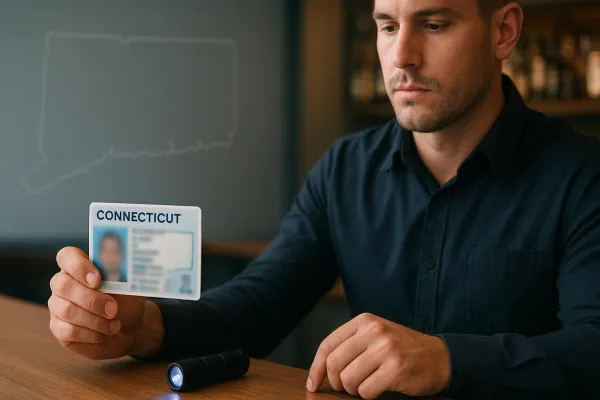
- UV inspection: If available, use a small UV light to look for legitimate fluorescence. Counterfeits frequently lack proper UV responses.
- Micro details: Check for microprint clarity, clean edges, and consistent letterforms. Look for punctuation or spacing errors in place names.
- Physical feel: Flex the card gently—quality stock feels consistent, not rubbery or brittle. Tactile elements should feel crisp, not “painted on.”
- Knowledge check: Ask the customer for ZIP code, middle name, or address cross‑checks; watch for hesitation or contradictions.
- Secondary ID and manager review: Request a backup credential; escalate to a manager if doubt persists.
- Scanner use: Where policy and law permit, use an approved ID scanner. A valid scan can support your decision process, especially for tobacco/e‑cigarette sales where scanner use is addressed by legislative research. See the Connecticut Office of Legislative Research’s summary of permitted scanning and data limits in OLR report 2022‑R‑0243.
Avoid over‑reliance on a single method. Scanners catch formatting and checksum issues, but well‑made fakes may still pass unless paired with human checks.
Escalation protocol: scripts, documentation, and safety
If suspicion remains, use de‑escalation and a clear process:
- Calm refusal script: “I’m sorry, I can’t accept this ID right now. If you have another government ID, I’d be happy to take a look.” Keep tone neutral and polite.
- Manager handoff: If the person insists, call a manager and restate policy. Don’t argue; repeat the refusal.
- Documentation: Record date/time, description of the interaction, and actions taken in your incident log. Follow company policy before retaining or copying any ID.
- Law enforcement: If you suspect criminal activity beyond a youthful attempt, or if a disturbance develops, contact local police. The Liquor Control Division offers guidance and handles disciplinary matters for permit holders.
Tools comparison: manual checks, scanners, and digital vendors
Below is a simple comparison to help you pick what fits your operation and compliance posture.
|
Method |
Strengths |
Limitations |
CT notes |
|
Manual checks |
Immediate;no hardware; trains staff judgment;detects obvious tells |
Human error; fatigue; hard to document |
Build a standard workflow; use training images; document incidents consistently |
|
Handheld/scanner |
Fast barcode/magnetic checks; logs decisions; supports affirmative defenses in some contexts |
Cost; maintenance; false positives/negatives possible |
For tobacco/e cigarette sales, OLR summaries note permitted scanning with strict data limits; check current policy and counsel |
|
Digital vendor verification |
Potentially strong remote checks and audit trails; useful for delivery/online sales |
Privacy, data retention, vendor reliability; may not be allowed for in person age restricted sales |
Confirm acceptance under CT law/regulation; ensure minimal data collection and retention in line with CTDPA |
For authoritative design principles in U.S. credentials, see the AAMVA DL/ID Card Design Standard (2025). For general spotting guidance by state (non‑governmental; cross‑verify locally), see Veriff’s state guide.
Digital age‑verification alternatives and Connecticut readiness
Mobile driver’s licenses (mDLs) and tokenized age attestations are getting attention, but Connecticut hasn’t signaled retail acceptance for in‑person alcohol sales as of early 2026. The state’s IT Strategic Plan references mDL planning, yet there’s no DMV rollout for retail checks. See the State of CT FY2026 IT Strategic Plan and DMV news pages. For now, train staff on physical IDs and approved scanners; treat digital alternatives as future‑watch items.
Privacy matters: If you use any electronic verification, align practices with Connecticut’s data‑privacy law (CTDPA). Keep only the minimal data necessary and avoid marketing reuse. The statute overview is available via Connecticut’s Data Privacy Act chapter index and the Attorney General’s CTDPA resource page.
Legal reference callouts (what’s at stake?)
Accepting or presenting a fake Connecticut ID may implicate multiple statutes:
- Forgery offenses: Falsely making or altering a government ID can be charged under Connecticut General Statutes. See the penal code index for forgery in the second and third degree.
- Criminal impersonation: Using another’s identity or a false persona is addressed in judicial guidance; see the CT Judicial Branch pathfinder for criminal impersonation.
- Sales to minors: Under the Liquor Control Act, selling or delivering alcohol to minors is prohibited, with disciplinary authority for fines or permit actions. See the chapter index and legislative analyses referencing § 30‑86: Liquor Control Act chapter index and OLR bill analysis noting DCP penalty authority.
Real‑world enforcement exists. As an illustration of disciplinary context, see a public DCP disciplinary decision (2025) referencing a Minor Field Report.
Training and next steps for managers
Operational consistency protects your business and your staff.
- Build a short, written policy: Define quick vs. deeper checks, escalation, and documentation expectations. Keep it posted at the POS and door.
- Run short drills: Practice during shift meetings—one person plays customer; another performs the check; rotate roles. Include rush‑hour scenarios.
- Maintain reference materials: Approved training images, updated legal callouts, and local law‑enforcement contact info.
- Review scanners and data practices: If you use scanners, confirm current CT rules on what data can be retained and for how long. Document your process for audits.
- Align with Liquor Control Division: Know how to request guidance and how disciplinary matters are handled. Stay updated via official channels.
So, are fake Connecticut ID cards useful?
For businesses, a fake Connecticut ID is useful only to someone intent on defeating your policy—a risk you can mitigate. With a tight 10–20 second check, a deeper 30–60 second workflow, disciplined escalation, and careful use of approved tools, you’ll keep lines moving, stay compliant, and protect your team. Here’s the deal: speed comes from standards, not shortcuts.