Keeping alcohol, cannabis, and age‑restricted venues compliant comes down to consistent, quick decisions at the door or POS. In 2026, that means knowing the basics of California’s 2025 DL/ID redesign, using a short visual–UV–scanner workflow, and documenting refusals cleanly. This guide is written for frontline staff and supervisors who need actionable steps—not theory—grounded in official guidance from the California DMV, ABC, AAMVA, and the Department of Cannabis Control.
Key takeaways
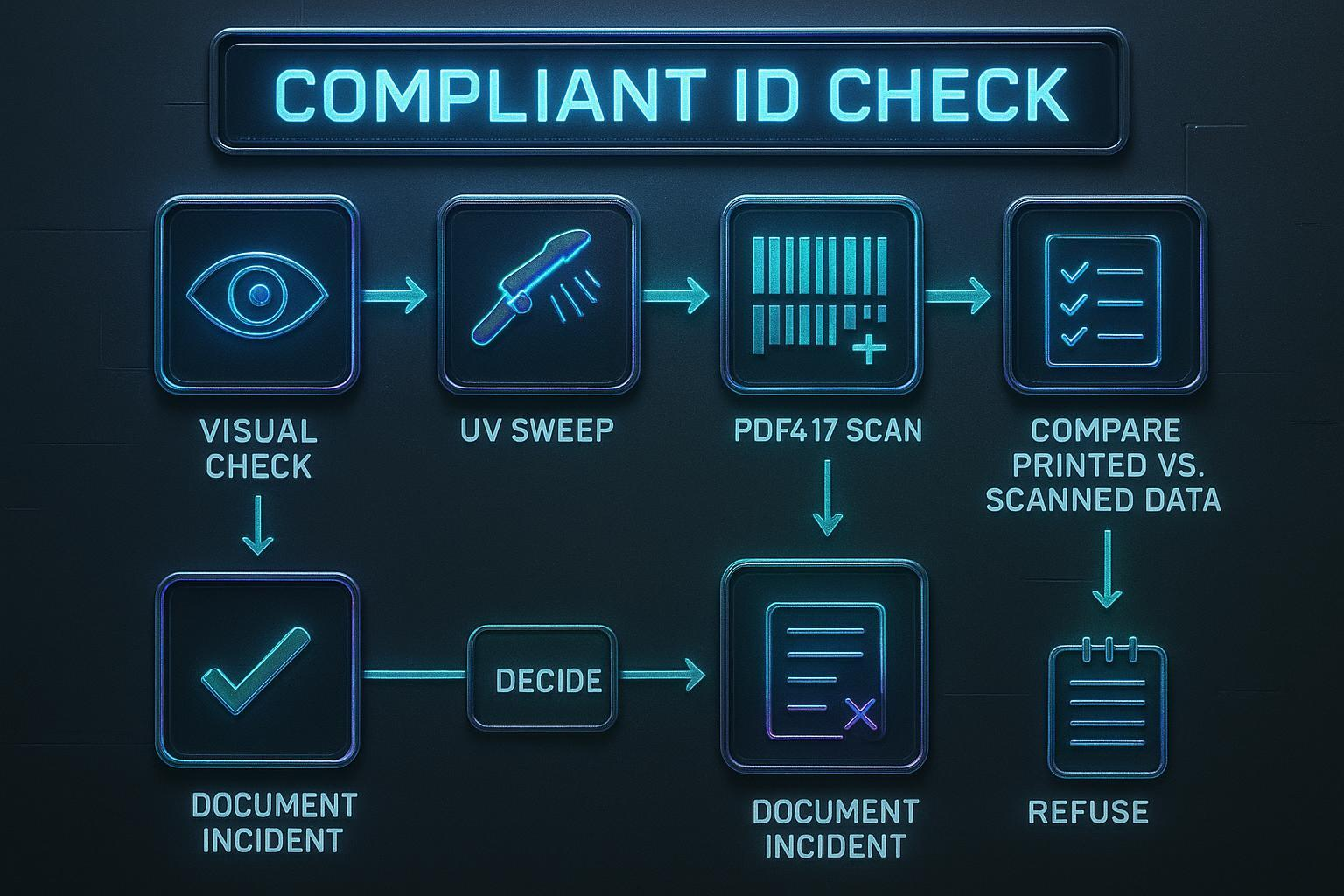
- Use a simple 30–60 second workflow: visual match and card condition → quick UV sweep → PDF417 scan and compare → decide and document.
- Your scanner decodes the PDF417 barcode; it should match key printed fields (name, DOB, document number). A match increases confidence but is not proof of authenticity (per AAMVA principles).
- The 2025 redesign removed the magnetic stripe and introduced advanced anti‑counterfeit elements; one back barcode includes a digital security signature per the DMV’s public release.
- REAL ID is for federal purposes (like domestic flights); it is not a shortcut for alcohol or cannabis service decisions.
- Follow ABC policy: refuse when you can’t confirm age/identity, and know seizure and documentation rules. Don’t detain. Be consistent and non‑discriminatory.
Before your shift: tools, setup, and policy guardrails
Your goal is a fast, repeatable check under real‑world conditions. Charge and test a small UV pen light, confirm you have an angled white light (your phone flashlight works at a shallow angle), and ensure a PDF417‑capable scanner or app is working and updated. Post or know your venue’s ID policy, have an incident log sheet ready, and make sure a manager is reachable. These practices align with the inspection approach encouraged in the California Department of Alcoholic Beverage Control’s guidance for checking identification.
The 30–60‑second frontline workflow to check a California ID
This is the core on‑shift process for how to spot a fake California ID without disclosing sensitive security details. Aim to complete it smoothly; a typical interaction takes half a minute to a minute.
- Greet, take the card, and check expiration. Hold the ID yourself to feel laminate integrity and spot obvious alterations.
- Photo and description plausibility: Does the face match? Are height and eye color reasonable? Does demeanor fit the age on the card? If anything feels off, slow down.
- Edges and surface: Look for peeling at corners, bubbling, cut‑and‑paste numbers, or rough edges. Tilt the card under angled light to reveal surface inconsistencies.
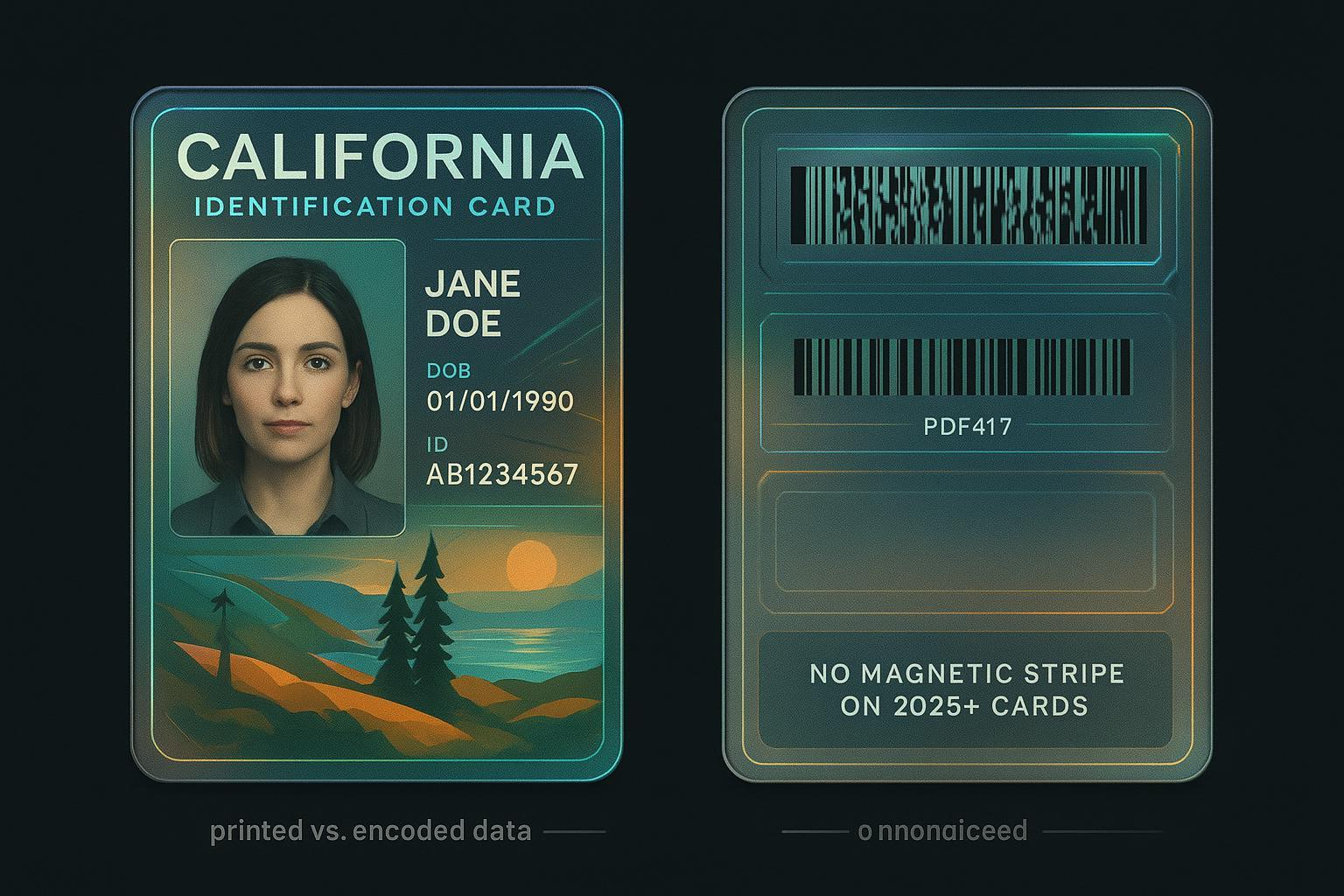
- Layout awareness (2025 redesign): Expect California landscape motifs on the face and two barcode areas on the back. Note that the old magnetic stripe is gone on 2025+ cards per the DMV’s public announcement. Don’t rely on any single element.
- Quick UV sweep (10–20 seconds): In a discreet area, make a brief pass to confirm expected non‑sensitive luminescent behavior. Treat UV as one data point—absence isn’t automatic proof of fraud, but paired with other red flags it merits escalation.
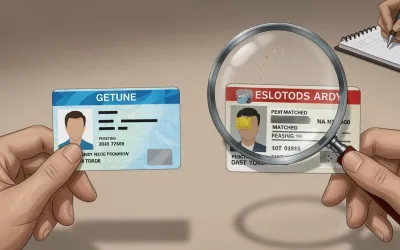
- Scan the PDF417 barcode: Use your approved scanner/app to decode. Compare printed vs. scanned name, date of birth, and document number. Unreadable barcodes, partial decodes, or any mismatch are strong reasons to deny or escalate.
- REAL ID awareness: A REAL ID indicator means the credential meets federal standards; it’s not a yes/no for service. Do not treat it as an authenticity guarantee.
- Decide and document: If doubts remain or mismatches appear, request an alternate acceptable ID (e.g., passport). If you refuse, document the interaction in your incident log.
What your scanner is (and isn’t) proving: PDF417 basics from AAMVA
Barcode scanning is powerful for catching tampering, but it isn’t magic. The AAMVA DL/ID Card Design Standard requires U.S. licenses and IDs to carry machine‑readable data in a PDF417 barcode, and the key principle for frontline work is consistency: the data encoded inside the barcode should match what you see printed on the card (for example, name, date of birth, and the document number). For a grounding reference, see the AAMVA DL/ID Card Design Standard (2025) and AAMVA’s topic hub on driver license and identification standards.
Practical takeaways for staff:
- A successful scan and data match increases confidence but does not prove authenticity. Counterfeits can carry barcodes that decode; use the full workflow.
- If the barcode won’t scan or the decoded data doesn’t match the printed face, deny or escalate per policy and document the reason.
- Keep your scanner/app updated and tested before a shift; lighting and print wear can affect decoding.
REAL ID and the 2025 redesign: helpful context, not shortcuts
REAL ID simply indicates the credential is compliant for federal identification purposes (like boarding a domestic flight). It does not replace your legal duty to verify age and identity before selling alcohol or cannabis. The DMV noted federal enforcement began May 7, 2025, and around 58% of Californians had REAL ID by that date, as stated in the DMV’s May 7, 2025 enforcement update.
On October 1, 2025, the DMV announced a redesigned California DL/ID featuring advanced anti‑counterfeit measures, removal of the legacy magnetic stripe, and a digital security signature embedded in one of the two barcodes on the back. The design also showcases California landscapes like redwoods, poppies, and the coastline. Existing cards remain valid until expiration. See the DMV’s announcement for public, non‑sensitive details: “DMV to release new California driver’s license and identification card design with advanced security features” (2025).
Troubleshooting common scenarios at the door or POS
Below are frequent edge cases and how to handle them within policy. Use this with your manager’s guidance and venue rules.
|
Scenario |
What to do now |
Policy note |
|
Barcode won’t scan but card looks fine |
Ask for an alternate acceptable ID (e.g., passport). Re attempt scan in better light. |
AAMVA: scan failure ≠ proof of fraud; ABC allows refusal when you can’t confirm age/identity. Document. |
|
Printed DOB and scanned DOB don’t match |
Deny service immediately; consider escalation. |
Mismatch is a major red flag. Note the reason in the log; follow seizure rules if clearly false. |
|
Interim/temporary paper DL presented |
Do not accept as stand alone ID; request passport or other acceptable ID. |
ABC materials list interim/temporary DLs as unacceptable for service. |
|
Damaged or altered laminate/edges |
Slow down, verify with UV and scan; request alternate ID if doubt persists. |
You may refuse if you can’t verify authenticity; be consistent and non discriminatory. |
|
Nervous or evasive behavior |
Stay calm, stick to the workflow, ask neutral confirming questions. |
Avoid profiling; base decisions on the document and your findings. |
|
Out of state ID |
Apply the same checks; scan when permitted. |
§25660 bona fide ID categories include valid out of state DL/ID; document decisions. |
Refusal, seizure, and documentation—scripts that keep you compliant
Here are short, neutral scripts you can adapt. Keep your tone calm and consistent.
-
If you must refuse after a mismatch: “Thanks for your patience. The information I’m seeing doesn’t match what’s on the card, so I can’t complete the sale tonight. If you have another acceptable ID, I’m happy to take a look.”
-
If an ID appears clearly false or shows the person is under 21 (alcohol context): “This ID appears invalid. I’m required to take it and provide you a receipt. It will be turned over to local law enforcement within 24 hours.” Follow your venue procedure and local law precisely. The ABC describes seizure authority and procedures on its education pages and in the ABC Act compilation; see its Minors guidance and the ABC Act.
-
If the customer argues: “I understand this is frustrating. My job is to follow state rules and our policy. If you’d like, I can ask a manager to review.”
California’s Business and Professions Code §25660 recognizes a “bona fide ID” reliance defense when you demand, examine, and reasonably rely on certain IDs (state DL/ID, passport, Armed Forces ID). See ABC’s resources and its recent precedential decision for timing/context clarity: Precedential Decision 24‑01‑E and ABC’s overview of checking identification. Use scanning outcomes as additional evidence but remember: a scan pass is not determinative.
FAQs for frontline staff
Does REAL ID mean the card is real? No. REAL ID indicates federal compliance for identification at airports and certain facilities. It doesn’t guarantee authenticity for alcohol or cannabis sales. The DMV’s May 7, 2025 update explains enforcement and adoption; treat the indicator as context, not a shortcut.
Can I accept a temporary or interim paper license? Treat interim/temporary paper DLs as unacceptable for alcohol service. Ask for a passport or another acceptable ID. ABC’s education and regulatory materials reflect this position; start with Checking Identification and related references.
If the barcode scans but everything else feels off, what should I do? Don’t let a clean scan overrule other red flags. Re‑check photo/description, do a quick UV sweep, and ask for another acceptable ID. Document the outcome. The AAMVA 2025 Standard underpins the scan‑and‑compare principle but doesn’t claim scans prove authenticity.
What about cannabis retail rules for age checks? Adult‑use customers must be 21+. Medicinal patients can be 18+ with a physician recommendation (and MMIC for certain benefits). Retailers must verify age/identity using valid government‑issued photo ID before any sale or delivery hand‑off. See the DCC’s Retail guidance.
Closing thoughts
A consistent, 30–60‑second workflow—visual match and card condition, quick UV, then PDF417 scan and compare—catches most issues you’ll encounter on a busy shift. Use REAL ID indicators and 2025 redesign awareness as helpful context, not shortcuts. When you can’t confirm age or identity, refuse politely, document the reason, and follow your venue’s procedures and ABC rules. For teams, schedule short refresher trainings, keep scanners updated, and test lights before each shift. Stay calm, be fair, and let the process do the work.