Serving alcohol in North Carolina carries real compliance risk. This guide gives frontline staff a clear, auditable process—grounded in the North Carolina ABC Commission (ABCC) and NC DMV—so you can check IDs consistently, refuse when necessary, and document incidents the right way.
Key takeaways
- Accept only four forms of ID in NC: a current U.S. state driver’s license, a U.S. military ID, a valid passport, or an NC DMV special ID card; out-of-state licenses are acceptable if current and valid.
- Use a simple flow: Ask quick questions → Check the document and person → Decide, escalate if unsure, and log refusals.
- Do not accept photocopies, screenshots, wristbands, stamps, or credit cards as age proof.
- If an ID appears fake or altered, refuse the sale, prioritize safety, and consider contacting Alcohol Law Enforcement (ALE); confiscation should be handled per ABCC guidance and house policy.
- Train and re-train: use the ABCC’s free RASP course, keep a written policy, and maintain an incident log for inspections.
Acceptable IDs in North Carolina
North Carolina recognizes only four acceptable identification types for alcohol sales:
- A current driver’s license from North Carolina or another U.S. state
- A current U.S. military identification card
- A valid passport
- A special identification card issued by the North Carolina DMV
Out-of-state driver’s licenses are acceptable when current and valid. Photocopies, images of IDs on phones, wristbands, stamps, or credit/debit cards are not valid proof of age. For the official list and practical screening steps, see the ABC Commission’s Quick Guide for Retail Permittees in the section on preventing underage sales. Review the guidance here: NC ABCC Quick Guide for Retail Permittees (April 2024).
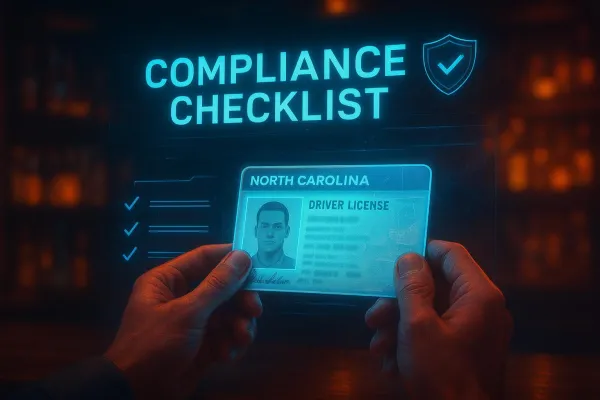
The 7-Step North Carolina ID check compliance checklist
Follow this fast, repeatable process at the door, bar, or register. It aligns with the ABCC’s practical ASK–CHECK–GIVE approach and the NC DMV’s credential security information.
- Request an acceptable government photo ID. Accept only a current U.S. driver’s license, U.S. military ID, valid passport, or an NC DMV special ID. Out-of-state licenses are fine if current and valid. See the official list in the ABCC Quick Guide.
- Ask quick verification questions. In a calm, neutral tone: “How old are you?”, “What’s your birthdate?”, “What’s your house number?”, “Which state issued your ID?” Inconsistencies are red flags; this mirrors ABCC’s ASK step cited in the Quick Guide.
- Match the person to the card. Compare the photo and physical descriptors (face, height, eye color). Look for mismatched facial structure or obvious changes not explainable on the spot.
- Verify DOB and do the age math. Confirm the guest is 21+ today. If you need a beat, cover the month and day and check the year quickly.
- Check expiration and surface integrity. Do not accept expired IDs. Watch for evidence of alteration: unusual thickness, bubbled laminate, misaligned text, or inconsistent fonts.
- Check security features with a quick tilt/touch. NC’s newest licenses are 100% polycarbonate with laser-engraved, tactile elements and numerous anti-fraud features; the card feels stiffer than earlier versions. A brief tilt or light sweep can reveal embedded effects. For an overview, see NCDMV’s New License & ID Cards. Note: a REAL ID star indicates federal compliance but is not required for alcohol purchases.
- If unsure, escalate—don’t guess. Ask for another acceptable ID if available, call a manager for a second look, or use approved tools (barcode/magstripe scanner, small UV light) to corroborate printed data. If contradictions remain or the person appears underage, refuse the sale, keep the interaction safe, and log the incident. For reporting and confiscation considerations, consult the ABCC Quick Guide and the ABCC Educational FAQs.
Pro tip: Scanners are supplements—not substitutes—for visual checks. Avoid storing personally identifiable information unless your policy, consent, and law permit it.
Fast red flags and when to refuse
Prioritize safety and consistency. If any of the “critical” items below appear, refuse the sale and follow house policy. “Warning” indicators call for manager review and possibly a second form of acceptable ID.
-
Critical
- Photo doesn’t match the person; height/eye color clearly off
- ID is expired or visibly altered (laminate bubbles, lifted edges, reprinted photo)
- Barcode/magstripe data conflicts with printed data
- Guest cannot state age or birthdate consistently
-
Warning
- Nervous behavior or rehearsed answers that don’t match the printed details
- Card feel is unusually flimsy for modern polycarbonate; surface text lacks tactile elements
- Spelling errors, misaligned fonts, or color inconsistencies
- REAL ID star missing isn’t itself a failure—use other checks and DOB verification
If a card appears fake or altered, decline the sale. The ABCC indicates employees may confiscate fake or altered IDs for the purpose of turning them over to law enforcement; involve a manager and prioritize safety. See the ABCC Educational FAQs (confiscation and reporting). For suspected violations, Alcohol Law Enforcement can be reached at (877) ALE-AGENT.
Documenting refusals and incidents
Consistent documentation shows diligence during inspections and can improve training. Keep one compact list of what matters—and protect privacy.
- What to record (and how to retain it)
- Date/time, location, and staff involved
- ID type presented (DL, passport, military, NC special ID)
- Specific reason(s) for refusal (e.g., expired, photo mismatch, barcode mismatch)
- Whether a manager reviewed; whether law enforcement was contacted
- ID disposition (returned, voluntarily surrendered for law enforcement)
- Store logs securely; limit manager access; avoid retaining scan data/PII unless your written policy and applicable law allow it
For the legal framework governing underage sales and potential penalties for permittees, consult North Carolina General Statutes Chapter 18B. For operational training, rely on ABCC resources rather than third-party summaries.
Training and next steps for your team
- Enroll staff in the free Responsible Alcohol Seller/Server Program: ABCC RASP training. Use it for onboarding and periodic refreshers.
- Adopt a written house policy covering acceptable IDs, use of scanners/UV lights, refusal scripts, and incident logging. Keep this North Carolina ID check compliance checklist printed at the door and behind the bar.
- Run quick huddles before busy shifts to rehearse the 7 steps; managers should perform spot checks and review logs weekly.
- Post a printed one-page version of this checklist behind the bar and at the door.
For quick reference to acceptable ID forms and ASK–CHECK–GIVE screening, bookmark the ABCC Quick Guide for Retail Permittees and the NCDMV license/ID design overview.