Crowded line. Low light. You have seconds to decide. This guide gives door staff a fast, repeatable, New York–specific workflow that fits the 10–15 second window and aligns with “reasonable reliance” standards.
Key takeaways
- Use a five-step, 10–15 second visual/tactile flow to quickly accept, escalate, or refuse.
- Stick to IDs New York alcohol law recognizes; rely only when the person matches and the ID isn’t expired, altered, or false.
- New York State Mobile ID (MiD) is acceptable when verified with approved software and consent, providing DMV‑signed data in seconds.
- If anything doesn’t add up, request a second acceptable ID or call a manager and document your reason.
The 10–15 second door checklist: how to spot a fake New York ID fast
-
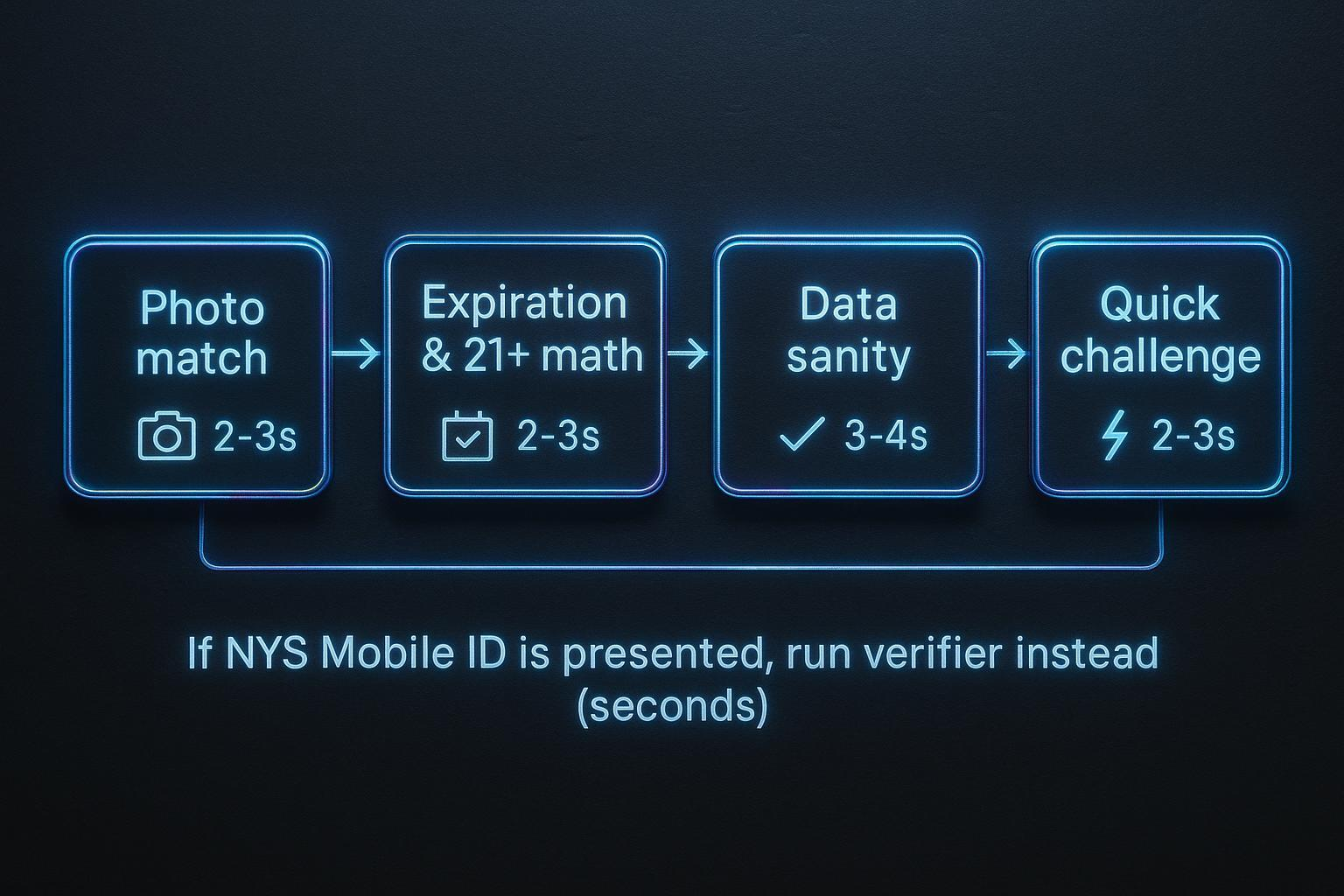
Photo match (2–3s): Scan facial structure, eyes, hairline, and overall age plausibility.
-
Expiration and 21+ math (2–3s): Confirm not expired; compare DOB to your posted “21+ today must be born on/before” date or do a fast YY check.
-
Data sanity (3–4s): Names spelled consistently, DOB format looks right, jurisdiction/class look ordinary, no obvious misprints.
-
Surface/tactile tilt (2–3s): Quick tilt and feel for uniform edges, intact laminate, consistent fonts/spacing; embossed elements should feel raised.
-
Quick challenge (2–3s): Ask for ZIP code or middle name from the card. Hesitation or mismatch = escalate or refuse per policy.
Why each step works
Start with the person, not the plastic. If the face in front of you doesn’t plausibly match the photo—bone structure, eyes, hairline, and age—you cannot reasonably rely on that ID. New York’s standard expects diligence; if it looks like a different person, stop.
A fast expiration and age math pass prevents two common failures: serving on an expired ID and transposition mistakes on the birth year. Posting a daily “21+ today” sign at the door gives you an instant reference, so you’re not doing long arithmetic under pressure.
Data sanity is your print check. Counterfeits and altered cards often carry spacing issues, inconsistent fonts, misaligned photo boxes, or typos that jump out once you’ve seen a few. You’re not hunting microprint; you’re looking for obvious tells in normal lighting.
A short tilt-and-feel catches tampering. Authentic NY cards from the current design include tactile elements (embossed text/images) and clear-window/laser imaging behaviors on enhanced documents that are hard to fake with home methods. Edges should be clean and thickness uniform; bubbled laminate or lifted photo areas are red flags.
The quick challenge turns a static object into a live identity test. Most borrowers of a “real” friend’s ID stumble on small details like middle name spelling or ZIP code. Keep the tone neutral and professional.
Use New York State Mobile ID when offered
When a patron presents NYS Mobile ID, you can complete the check in seconds with a privacy‑respecting, contactless flow. Using a verifier app, you scan a QR that starts a secure Bluetooth session, request only what you need (e.g., over‑21 confirmation, photo, DOB), and the patron approves on their device. The result is DMV‑signed data for you to compare to the person in front of you. See the DMV’s guidance for verifiers in the page on Mobile ID for businesses and organizations and the holder overview in Mobile ID for license/ID holders.
New York’s regulator has explicitly addressed reliance on MiD in alcohol sales. According to NYS SLA Advisory 2024‑2 (Oct. 30, 2024), you may rely on MiD when: your software is approved/validated, you request specific data, the holder consents to share it, and you diligently compare the shared data and the person. If the person does not match, or the data is denied or appears false, you cannot reasonably rely on it.
For adoption context in nightlife, the DMV has highlighted hospitality demonstrations and reminders, such as the Common Roots Brewing MiD demonstration and a St. Patrick’s Day message to get Mobile ID before you go out.
Troubleshooting and escalation scripts
- If barcode won’t scan or card seems off: “I’m not able to verify this quickly. Do you have another acceptable ID we can check?”
- If the quick challenge stumbles: “Thanks. I’m getting a mismatch on the details. I’ll need to see a second acceptable ID or I can’t let you in tonight.”
- If MiD is offered but verifier isn’t available: “We can’t run Mobile ID right now. If you have a physical driver license or passport, I can check that instead.”
Documentation that protects you
New York law recognizes reliance when diligence is shown and, where applicable, transaction scans are performed and retained. The SLA notes that you cannot rely on an expired, altered, or false ID, or a photo that does not match the presenter. When available, keep simple records that support your good‑faith check: scanner or MiD verifier logs, date/time, your initials, and a short reason if you refused or escalated. See the reliance framework and records context in NYS SLA Advisory 2024‑2 and general diligence cues in SLA’s retailer guidance.
Setup that speeds checks
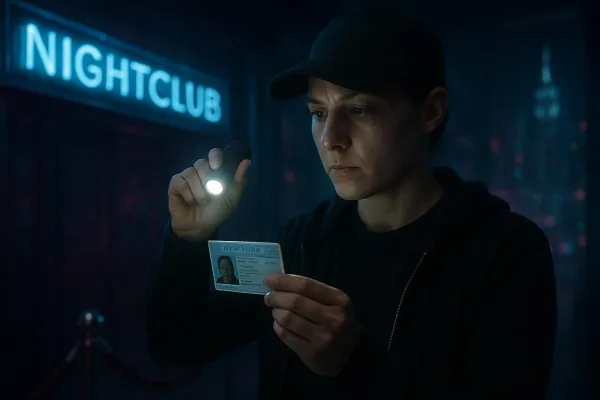
Give yourself light and a reference. Mount a neutral‑white LED near the entry or keep a small pocket light to cut through colored club lighting. Post a clearly visible “21+ today must be born on/before” sign at eye level so you can confirm DOBs without mental math. If you use scanners or MiD verifiers, test them before the rush and keep a backup plan if they’re down.
Legal and compliance notes (read this)
- Acceptable ID scope: New York’s Alcoholic Beverage Control Law recognizes driver licenses or non‑driver IDs issued by U.S. jurisdictions (including NY DMV), valid passports, and certain federal IDs. For context and compliance practices, review SLA’s frequent violations and retailer guidance. College or employee IDs are not primary proof of age.
- Physical card cues: The DMV’s redesign highlights tactile features like embossed text/images and updated clear windows on enhanced documents that behave when tilted. See the summary in DMV’s 2022 security redesign release. Avoid relying on unofficial hologram/UV lore.
- Disclaimer: This guide is informational and not legal advice. Confirm your venue policies with counsel and follow manager instructions and NYS SLA requirements.
Next steps for managers
Run a short drill with staff using the five‑step flow and time it to 10–15 seconds. Post the daily 21+ date, confirm your escalation script, and ensure your MiD verifier or scanner is working before doors open. Align documentation practices with your counsel’s guidance and the SLA advisory.